Showing posts with label Technology. Show all posts

Tuesday, March 10, 2009

Hamster Jackets Harness Wheel-Running Power

Photographer: Zhong Lin Wang
Wheel Power This image show an experimental test of piezoelectric nanowires that harness a hamster's wheel-turning energy into usable power. Fifty nanowires bundled together would be about the width of a single human hair. Discovery News Video

by Eric Bland, Discovery News
March 9, 2009 -- Hamsters can seemingly run forever inside their little wheels, and scientists from Georgia Tech are finally helping them get somewhere.

To harness hamster power, the scientists sewed electricity-generating threads one-fiftieth the width of a human hair into a yellow jacket worn by the hamsters as they ran. A human-sized jacket, capable of powering an iPod, could be ready in as little as three years.

"This can totally be scaled up," said Zhong Lin 'ZL' Wang, who co-authored a paper describing the research in this month's issue of Nano Letters. "This is just the first step. The idea is that we would harvest energy from any body movement, from walking, breathing, from any kind of vibration."

The jacket's tiny threads are really nanowires made of zinc oxide, the same white stuff smeared on the noses of lifeguards. When the nanowires are flexed, a small amount of electricity is generated.
A zinc oxide wire is one micron wide and 50 microns long. One wire sewed into the hamster jacket generates about 0.1 volts of electricity. According to Wang, this is the world's first example of an animal producing power using nanopiezoelectrics -- a field of research that aims to capture tiny amounts of energy from movement and vibration, and transform it into usable power.

A bundle of 50 nanowires one human hair wide would be able to generate more than enough energy to power sensors that could monitor temperature and other conditions.

Powering an iPod would require hundreds of nanowires, covering an area equivalent to several human hairs. A thousand hamsters wearing the current jacket could charge a cell phone. Campbell's Dwarf, one of the hamster test runners, was able to generate one-twentieth the power of an AA battery.

But don't rush out to the pet store for your own personal rodent power plant yet. Wang estimates that it will be at least three years before his team can create enough nanowires to create a piece of fabric capable of powering a personal electric device.
"It's not something that you can immediately use for specific applications," said Min-Feng Yu, a scientist at the University of Illinois who creates piezoelectric nanowires but was not involved in the Georgia Tech study. "It's the combination of voltage and current."

Getting large voltages out of the piezoelectric nanowires is only half the battle. Scientists also have to generate large, continuous currents to directly power electrical devices. A battery could store any power generated from the tiny wires when they aren't moving but would complicate the current set up, adding weight and complexity.

Linking a shirt to an iPod is just one possible application for the new technology, said Wang. A whole range of tiny biological or environmental sensors could be created using the technology as a power source.

"Current power sources are large or antiquated to be implanted into biological systems and don't take advantage of the low power consumption," said Wang. "But if you can harvest that energy from the environment or body movement, you can have a self-powered nano system, providing not only energy for itself but for other devices as well."

Saturday, February 7, 2009

Inside the House of the Future

Green technology, wireless connectivity, and less ostentation
are just some of the newest home-building trends
When the homebuilding industry descends on Las Vegas on Jan. 20 for its annual trade show, a highlight as always will be a project called the New American Home. This model house—a new one gets built each year—serves as a showcase for the industry's latest technology and trends. The massive four-bedroom, five-bath structure popping up in suburban Las Vegas this year may seem a little out of touch with the times as the nation suffers through the worst housing slump in decades. But out in the real world, architects and builders are busy trying to figure out how to put some of the same design features into new homes. Such trends are worth noting: Having amenities that appeal to buyers a decade or more after your house is built will help it hold its value. We list below some of the most important new design features you'll see in homes.
Indoor/Outdoor Living Just since 1992 the number of U.S. homes built with patios or porches has doubled. The New American Home in Las Vegas has a giant backyard that features a covered area with a flatscreen TV and pool table as well as a detached "rejuvenation room" for relaxing. New homes in warmer climates are being built with courtyards that provide a connection to the outdoors but also give shelter from wind and privacy from neighbors. This is critical as builders try to cram larger houses onto smaller lots to keep land costs down. And there's a history to them, notes Newport Beach (Calif.) architect David Kosco: "The courtyard goes back to Roman times."
The Return of the Basement With lot sizes limited, builders are looking for space underground. Once a typical feature of homes in the Northeast, basements are rising in popularity nationally as a way to create extra space. New technologies in insulation and waterproofing are allowing builders to add basements in any climate. They can serve as game rooms for kids, home theaters, or just the "man-cave" for Dad. Builders are even creating underground garages for homes and townhouses to free up space for living areas above, notes Irvine (Calif.) architect Rick Emsiek.
The Death of the Living Room The kitchen, living, and dining areas are continuing to merge into a great room or family room. In a 2007 study conducted by the National Association of Home Builders, half of those surveyed said they would do without a formal living room if it meant a larger family gathering space. In some cases this is a refection of the connection to the outdoors as well, as home buyers want fewer walls and unobstructed views out into the backyard, says Craig Delahooke, director of custom development for John Laing Luxury Homes.
The Home Office No longer just a spare bedroom, the home office is evolving into an entirely separate structure such as a casita in the backyard or even a separate wing near the garage. Having a separate entrance for the home office allows today's increasingly mobile workforce to receive work-related visitors or hire an assistant at home without having these people traipse through the main house.
Wireless, but not Cordless With wireless laptops allowing people to carry their computer to any room, that little computer nook that was popping up at the top of the stairs in many new homes is starting to disappear. Instead you're likely to see a charging station or "Mom's Desk," a little space, typically in the kitchen, where cell phones, laptops, and other devices can be charged.
The Soft Loft The industrial look with concrete floors and exposed brick is over. Thousands of these pseudo SoHos popped up even in cities such as Dallas and Houston that lacked an industrial past. Downtown lofts have seen some of the steepest price declines in this bust. "Architects love to show these wide-open floor plans, but the reality is people want some privacy," says Los Angeles architect Jonathan Watts. He says new condos are returning to more traditional floor plans. Lofts are adding hardwood floors, sliding doors, even wall-to-wall carpeting to warm them up.
Say Bye to Bling As befits this economy, homes are getting less ostentatious. That means less ornate wood, stone, and iron work. No more grand entrances with curved-marbled staircases. The stairs are shifting to the side of the home and back to their utilitarian purpose. Even fireplaces are flickering. Only 46% of all new homes came with one in 2007, according to the U.S. Census. That's down from 59% in 1996.
The Green Badge of Honor It almost goes without saying, but green continues to be in, despite the latest slide in gas prices. Even the giant New American Home promises to use "net-zero energy" thanks to devices such as solar panels and designs that let in natural light. Home buyers used to love wowing their friends with the size of their McMansions. Now, says Sean Degen, vice-president for architectural services at home building giant Pulte Homes, "you're going to see more people having a green badge of an honor."
Aging in Place Builders say it's rarely something they overtly try to sell, but consumers are responding to features such as wider doors that can accommodate a wheelchair or walker, master bedrooms on the first floor, and tasteful looking handrails in the shower—amenities that will help baby boomers stay in their homes as they grow old.

Palmeri is a senior correspondent in BusinessWeek's Los Angeles bureau.

Saturday, July 12, 2008

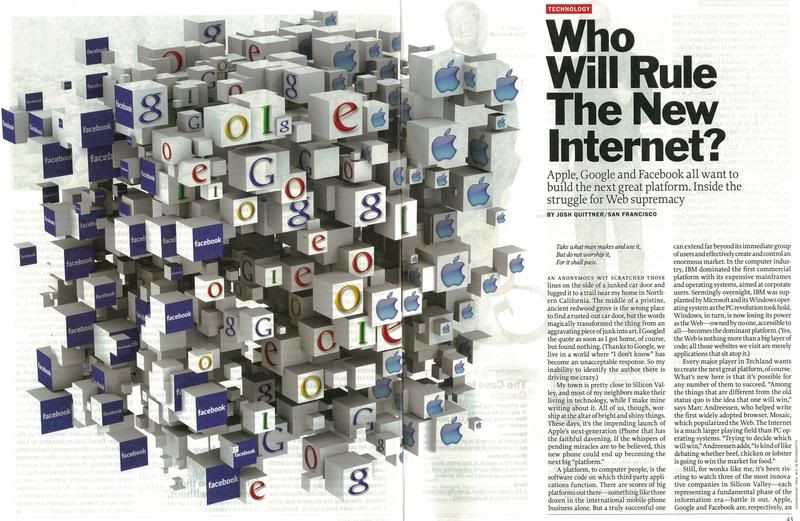
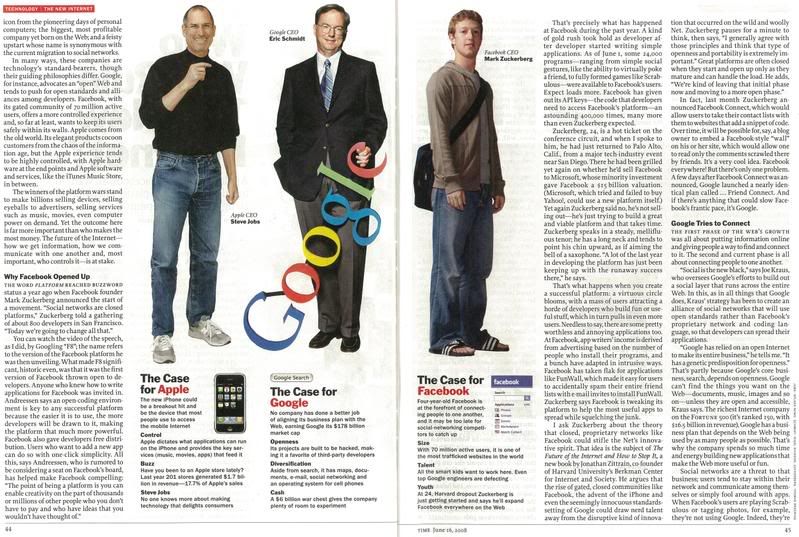
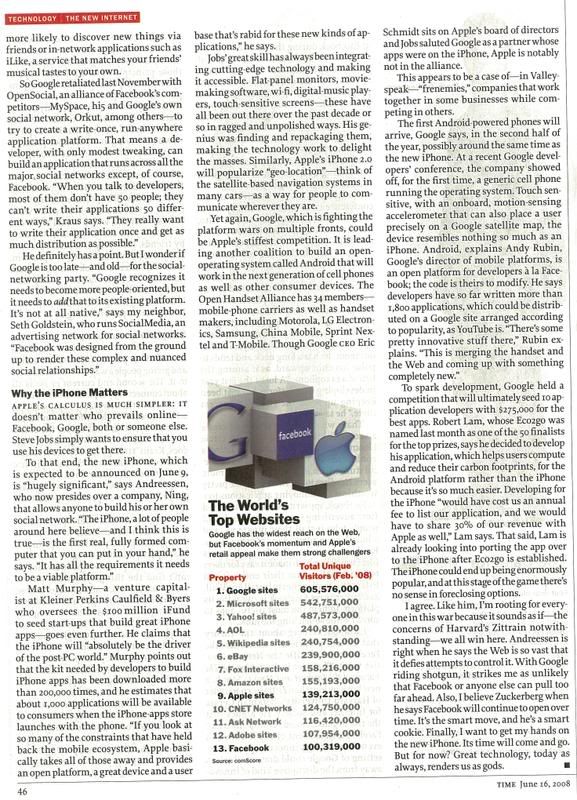
Who Will Rule The New Internet?


Apple, Google and Facebook all want to build the next great platform. Inside the struggle for Web supremacy

by Josh Quittner/San Francisco

Source: Time Magazine of June 16, 2008

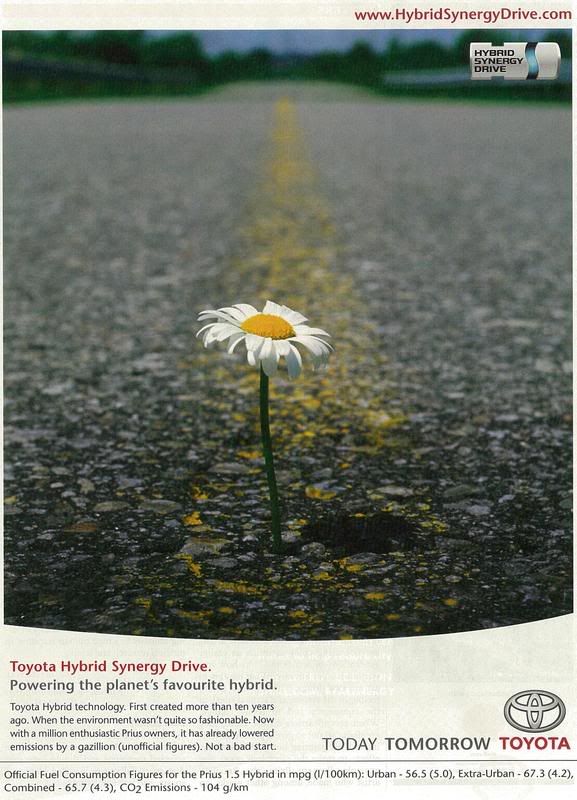
Toyota Hybrid Synergy Drive

Source: Newsweek Magazine

Thursday, August 9, 2007

Safest Cars 2007


If you’re going to get creamed in a car, might as well make it an Audi A4.
That’s because it’s one of the safest cars on the road, according to data we consulted in forming this year’s list of most sound autos.
Joining it at the top? Acura's
RL and Saab's 9-3. All three get the highest-possible marks for safety from three of the four most respected sources of such data: Consumer Reports, the Department of Transportation, the Insurance Institute for Highway Safety (IIHS) and the Highway Loss Data Institute (HLDI).
What's more, all three vehicles carry CR's highest-possible rating for accident-avoidance capabilities. The Acura RL also has perfect crash-test scores from both the Department of Transportation's National Highway Traffic Safety Administration (NHTSA) and from the IIHS. The A4 and 9-3 have perfect IIHS crash-test scores, as well as substantially better-than-average (in this case, lower-than-average) frequencies of insurance injury-claim filings, according to HLDI.

Behind The Data
To earn a spot on our list, a vehicle had to have at least two of the following:
--CR's highest-possible rating for accident-avoidance capabilities. --Perfect NHTSA crash-test scores across the board. --Perfect IIHS crash-test scores across the board. --A substantially better-than-average (i.e. lower-than-average) frequency of insurance injury-claim filings, according to the HLDI.

We only looked at cars that the NHTSA and the IIHS have tested in all of their available categories: for NHTSA, two frontal-impact tests, two side-impact tests and a rollover-resistance test; for the IIHS, front, side and rear tests.
The difference between a good crash-test rating and a poor one is significant: A five-star NHTSA frontal-crash rating means a chance of serious injury of 10% or less in a head-on collision in which each vehicle is going 35 mph. A one-star rating means a chance of 46% or higher. NHTSA defines a "serious injury" as one that requires immediate hospitalization and may be life-threatening.
Safe Sex
Wondering if it’s possible to achieve safety and sex appeal?
Answer, please: Yes. Oh Yes.
Take the sporty BMW
Z4 coupe. A two-seater, it accelerates from zero to 60 in 4.9 seconds and boasts a 6-cylinder, 3.2-liter engine. Rounded fenders and flat rear glass add a touch of class.
Or the Lexus
SC convertible. It reaches a top speed of 149 mph thanks to a 4.3-liter V-8 engine.
Both also received Consumer Reports' highest-possible rating for accident-avoidance capabilities and a substantially better-than-average frequency of insurance injury-claim filings, according to the HLDI.
Think about that the next time you’re leaning more toward daring than dependability.

Sunday, April 22, 2007

Dell Tablet PC coming this Fall?

by Peter Rojas

Source: www.engadget.com

Quite a few people have been hoping that PC maker Dell would come out with a Tablet PC. Not only would a Dell Tablet PC help validate the platform it would also make it easier for companies who use Dell computers exclusively to make Tablet PCs available for those employees who prefer them. There have been rumors of a Dell Tablet PC for months and I recently received some additional information that sounds very credible. A jkOnTheRun reader who wishes to remain anonymous recently discussed the Dell Tablet with two Dell representatives at two different public events and this is what he was told by Dell:

Dell will release a Tablet PC in the September/ October 2007 time frame
The Tablet PC will be based on the Latitude D420 notebook computer and will be a convertible Tablet.
It will be compatible with all Latitude D series accessories such as docking stations, power adapters, etc.
This Tablet PC will be the last system released in the popular Latitude D series.
The Dell Tablet PC will have an active digitizer only.
Wireless Broadband will be an option
Widescreen display

Like all Dell Tablet PC rumors you need to take this with a grain of salt but it seems like a very credible piece of information. It's worth a look at the Latitude D420 specs to get a feel for what the Tablet PC might have under the hood:

Intel Core Duo up to 1.2 GHz processor
Up to 2 GB of RAM
Intel Graphics Media Accelerator 950 (up to 224 MB shared memory)
WXGA (1280 x 800) 12 " widescreen
SATA hard drive (up to 60 GB)
Three primary battery options (4, 6, 9 cell)
Bluetooth, WiFi (a/b/g)
WWAN CDMA from Verizon

Saturday, April 21, 2007

First Citywide Sensor Network Planned

By Tracy Staedter, Discovery News

Source: http://disc.discovery.com

A network of sensors to be installed on and powered by city streetlights in Cambridge, Mass., could make urban monitoring easier than a doctor's visit.
After all, a city's health, like a person's, can benefit from regular checkups. But monitoring such physical factors as weather and air quality are typically time-consuming and labor-intensive.
The CitySense project, led by researchers from Harvard University and Cambridge-based BBN Technologies, will disperse about 100 wireless devices to collect weather and air quality information about the city, and will also serve as a research platform for other scientists to experiment with sensor networks.


"Our network is a backbone. It's an experimental testbed. Scientists from all over the world will be able to program these nodes," said Matt Welsh, team leader and assistant professor at Harvard.
The network will consist of nodes, each about 6 inches by 6 inches square and 3 inches deep, bearing a processor and a memory board sheathed in a weather-resistant case. They will run on Linux and use a USB memory card for storing data, as opposed to an internal hard drive that could fail in the extreme weather swings of Massachusetts.
Instead of receiving and transmitting data to and from a central hub, each node will communicate with its nearest neighbors to form a mesh network. In these networks, data hops from one node to the next, leapfrogging over those that are busy or damaged.
Several sensors attached to each device will monitor pollution and weather variables such as humidity, barometric pressure, wind speed, wind direction, temperature and rainfall. That's for starters, but there is the potential for expansion.
The idea, said Welsh, is that scientists would be able to log onto an Internet site for the network and request research time. They could upload and test their own software or work with Welsh's team to integrate other sensors into the network.


But before that can happen, the group needs to make the system robust. By the end of this summer, they plan to have about 20 sensors deployed around the Harvard campus as well as on the BBN Technologies building, a couple of miles away. In another three years or so, they plan to have the remaining 80 sensors distributed across Cambridge.
"The challenge is to keep it up and running," said Ramesh Rao, professor of electrical and computer engineering and director of the California Institute for Telecommunications and Information Technology at the University of California, San Diego.
And that may require a lot of handholding and some customer support that currently doesn't exist.


"The difficulty should not be understand estimated," he said.
Public perception could also be an issue. People may not approve of the sensors, even if the devices promise not to infringe upon privacy, said Rao.
"When you say the sensors can do 'x' but not 'y,' do people believe you? That sounds like a 'trust me' statement. How do they know that for sure?" he said.
Initial data gleaned from the CitySense project will be incorporated into one of the first high-resolution studies of urban pollution. Welsh is also working with Tufts University to develop a educational curriculum for K-12 students to better understand sensor networks.

Lenovo: Down So Long, It Looks Like Up

Integrating IBM's PC division continues to tax China's No. 1 computer maker, but growth is up, and more job cuts are cheering investors

by Bruce Einhorn
Source: Businessweek.com


Promising a Payoff
Although the IBM deal catapulted Lenovo into the top tier of PC makers globally, the company has been losing market share. On Friday, market research firm International Data Corp. announced its numbers for the first quarter, showing that Taiwanese rival Acer had climbed into a tie with Lenovo at 6.7%.
The Taiwanese have the wind at their backs: While Lenovo's sales climbed 17.4%, Acer's jumped 41.4% (see BusinessWeek.com, 1/07,
"Acer Closes in on Lenovo").
Still, Amelio promises the payoff is coming. Lenovo's first-quarter sales growth wasn't as sizzling as Acer's, but it still topped the 10.9% growth of the overall market and certainly outshone the 6.9% slide that Dell suffered. Moreover, the newest cutbacks will cost the company between $50 million and $60 million (to be charged this quarter), but management believes Lenovo will see $100 million in savings for the year.
Are there more cuts to come? Maybe, but Amelio says the shrinking at Lenovo might be over.
"We believe the 'tipping point' is within reach," the executive said in a statement released by the company as it announced the layoffs. "If we can combine optimal cost competitiveness and efficient delivery capabilities with innovative, best-engineered products, we can generate more profitable growth, gain market share, and make further reinvestments into the business, fueling more growth."


Moving Up in the World
Investors were cheered by the news of the layoffs. Lenovo's stock price rose 2.1% in Hong Kong trading on Friday. Some other good news for Lenovo came on Friday with the announcement by IDC that the company had expanded its lead in Asia Pacific (excluding Japan) in the first quarter.
While the market as a whole grew 17.6% year-on-year in the first three months of 2007, Lenovo enjoyed 24.3% growth. Lenovo is tops in the region, with 17.8% of the market, compared to No. 2 Hewlett Packard's (
HPQ) 15.4%. And this progress came at a time when sales in China slumped because of the weeklong Chinese New Year holiday; that's a sign Lenovo is becoming more of a player in other countries around the region.