
Wednesday, May 28, 2008


Monday, May 19, 2008
Meraviglia o terrore?
 In Italian only
Source: www.focus.it
Meraviglia o terrore? Quale delle due per la nuova scienza che progetta di costruire macchine delle dimensioni di una molecola, o più piccole, capaci di gareggiare con gli atomi? Macchine, e non per modo di dire: hanno motori, computer di bordo e strumenti per "fare qualcosa" (anche dentro di noi!). Tutto proporzionato, è naturale, e tutto in violazione alle comuni leggi della fisica: la gravità, la forza di van der Waals (attrazione intermolecolare), la seconda legge della termodinamica (il calore fluisce da un corpo caldo a uno freddo), la tensione superficiale... contano poco o nulla per un robot grande un atomo. È ANCORA FUTURO Il primo a sognare macchine così, nel 1959, è stato Richard Feynman (Nobel per la fisica 1965), quando ancora non esistevano né la parola "nanotecnologia" né gli strumenti per assemblare nanostrutture, come il microscopio a forza atomica (1986), uno dei principali attrezzi per l'osservazione e la manipolazione della materia in scala nanometrica (vedi "La scienza incontra l'arte"). A che punto siamo oggi? Per le idee rappresentate in queste pagine dai disegni di tre artisti è ancora piena fantascienza. Sono però "mondi possibili" e la nostra domanda è, di nuovo, sogno o incubo? Che cosa ne pensi? I MANGIA-LIPIDI Non c'è tempo da perdere: quest'arteria è ingombra di placche di grasso! Da smaltire, prima che succeda qualcosa di peggio. Una flotta di nanorobot rimuove il materiale lipidico e lo digerisce direttamente sul posto.
(© Tim Fonseca)
[Elisabetta Intini, 15 maggio 2008]
Wednesday, May 14, 2008
Photo.net's Photo of the Week - May 12, 2008
 Photographer Kevin McNeal
Caption A Rare Perspective Of San Francisco Under The Bay Bridge
Views 655 times
Ratings 25 ratings, Aesthetics: 6.72/7 Originality: 6.80/7
Exposure Date 2007-03-29
Location City: San Francisco State: California Country: U.S
Equipment Camera Canon Canon 5D
Technical Details I know this is an icon but I had never seen it ever from here until I saw a similar image. I owe this image to Ed Nunez who I had visited to shoot the Big Sur Coastline with. I wanted to get to this location but he told me it is almost impossible as this is on government property and has pretty tight security due to obvious reasons of late. I told him I had to have it for myself and I would do whatever it took. So we drive there as the sun set and he asked me to jump out the car without stopping and make my way down the steepest embankment of my life all the way down to the water. He could not stop as the police were constantly patrolling the area and I only had a matter of seconds to get out of sight. Once I finally got to the spot I could not setup my tripod due to the steepness; So I dug a deep hole to get my tripod legs into. I could not even put my bag down as it rolled down the hill. I know that a lot of people will disagree with this but when you are desperate to get a rare perspective you will do anything !!! Thanks again to Ed Nunez who made this possible. Thanks for looking ! Canon 5D 17-40L f/11 25 seconds ISO 100
Manipulated? Unknown or Yes
Friday, May 2, 2008
Photo.net`s Photo of the Week - April 28, 2008
 Biliana`s note: *W*O*N*D*E*R*F*U*L*
Photographer Don Paulson
Caption Japanese Garden ~ Royal Roads University
Views 54545 times
Ratings 34 ratings, Aesthetics: 6.09/7 Originality: 5.82/7
Exposure Date 1996-11-04
Location Vancouver Island, British Columbia, Canada
Manipulated? Unknown or Yes
Thursday, March 27, 2008
In the Middle of a War Zone...
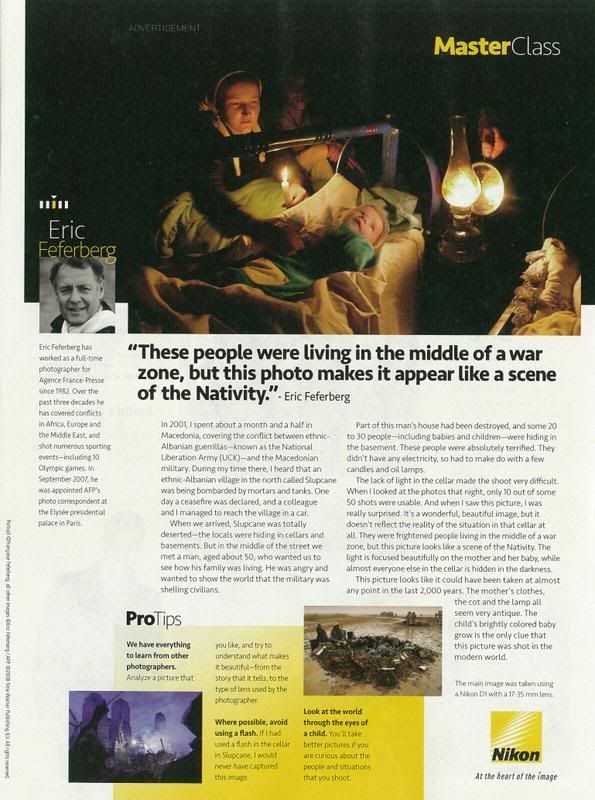 ... and an incredible artwork of Eric Feferberg.
 Speechless.
Source: Time Magazine of March 24, 2008
Thursday, March 20, 2008

Wednesday, March 12, 2008
Photo.net`s Photo of the Week - March 11, 2008
 Photographer filip bogdan
Views 20722 times
Ratings 140 ratings, Aesthetics: 6.49/7 Originality: 6.70/7
Location City: bucharest Country: roumania
Equipment Camera Kodak DCS Pro SLR/n
Manipulated? Unknown or Yes
Wednesday, February 27, 2008
Photo.net`s Photo of the Week - February 25, 2008
 Photographer Max Billder
Views 70294 times
Ratings 120 ratings, Aesthetics: 6.62/7 Originality: 6.62/7
Location Country: Spain
Equipment Camera Canon EOS 30D, Lens Canon EF 70-200/2.8L IS USM
Technical Details iso100, 1/100, f22
Manipulated? Unknown or Yes
Friday, February 1, 2008
Where Hunger Will Hit in 2030
 Marshall Burke
Uncertain FutureA rice farmer in strolls in Bali, Indonesia. A new study looking at the effects of climate change on crop production suggests rice systems throughout Asia will likely suffer in future decades.
Source: www.dsc.discovery.com
Sarah Gofort, Discovery News
Jan. 31, 2008 -- Some of the world's poorest regions could face severe food shortages in the coming decades thanks to climate change, say researchers who have consulted the most sophisticated climate models to predict where crop losses are likely.
According to those models, the world's average temperature could rise by 1.8 degrees Fahrenheit in the next 20 years. The difference may seem small in abstract, but coupled with changes in rainfall, it could have dramatic effects on the growing seasons of important crops.
Most of the world's 1 billion poor depend on agriculture for their livelihoods, points out David Lobell, lead author of a new paper on the predictions and a senior research scholar at Stanford University's Program on Food Security and the Environment (FSE).
"Unfortunately," he said in a statement, "agriculture is also the human enterprise most vulnerable to changes in climate."
To figure out which regions might be hit the hardest, Lobell and his colleagues used 20 climate models, focusing on poor regions in Asia, sub-Saharan Africa, the Caribbean and Central and South America. Their findings will be published in the Feb. 1 issue of the journal Science.
"We decided that a systematic look at the data might be helpful in identifying which crops and regions have the worst, or best, prospects," Lobell told Discovery News.
Though more rain -- and more crops -- are predicted for a few of those regions, the vast majority are drying up.
The researchers also compared the climate projections to past data on what people eat. Like a farmer's almanac, information on how temperature swings and rainfall patterns have affected growing seasons in the past gave them an idea of what to expect in the future.
The prospects are grim.
Their analysis revealed two "hunger hotspots" -- southern Africa and South Asia -- where regional staples such as maize and rice could drop by 10 percent or more.
Dealing with the problem could be cheap in some places, where farmers can plant earlier or later in the growing season. But the best solutions, said Lobell, require investment in technologies to pipe in more water and turn fallow land fertile.
Aid agencies, said Lobell, need advance warnings of potential hunger situations. To make this happen, the United States Agency for International Development has created a discipline-crossing program called FEWS NET (for Famine Early Warning System).
"Climate change is an opportunity to do the work we should have been doing all along, helping farmers to increase their agricultural productivity," said FEWS NET researcher Molly Brown, of the Biospheric Sciences Branch at the Goddard Space Flight Center in Greenbelt, Md.
In a paper accompanying Lobell's study in Science, Brown and co-author Chris Funk of the University of California, Santa Barbara, call for more attention to predictions like Lobell's.
"A changing climate will force the political and economic systems to change so that people can continue to live and work in semi-arid regions. We see it as an opportunity to improve the food security of the poorest and most vulnerable," Brown told Discovery News.
"The Lobell study highlights some very significant red flags in terms of global food production," said Funk, adding that his own work suggests an even "more pessimistic precipitation outlook" than Lobell's.
"On the other hand, I firmly believe that effective responses to these issues are possible," he said. "What will be needed, however, is real political commitment to change, both by the international community and by individual countries in the developing world."
Tuesday, January 15, 2008
Photo.net`s Photo of the Week - January 14, 2008

Photographer Aaron Brown
Caption A certain gleam in her eye
Views 1826 times
Ratings 43 ratings, Aesthetics: 6.12/7 Originality: 5.74/7
Exposure Date 2007-09-14
Location City: Cedar Park State: Texas Country: USA
Equipment Camera Canon EOS 30D
Lens Canon EF 100 f/2.8 USM Macro
ISO 100
Exposure Time 1/250 second
Time of Day 4:11 PM
f/stop f/6.3
Focal Length (mm) 100mm
Technical Details 2 studio strobes & a silver reflector :) Shot RAW, developed in Adobe Lightroom 1.3.1
Manipulated? Unknown or Yes
Subscribe to:
Posts (Atom)